
A Welded Plate Heat Exchangers offers the high thermal efficiency of plate technology in a robust, fully-welded design, eliminating the need for gaskets. This makes them the ideal solution for high-pressure, high-temperature, and aggressive fluid applications where reliability is critical and downtime is not an option. Their compact footprint and superior heat transfer make them a powerful alternative to traditional Shell & Tube exchangers.
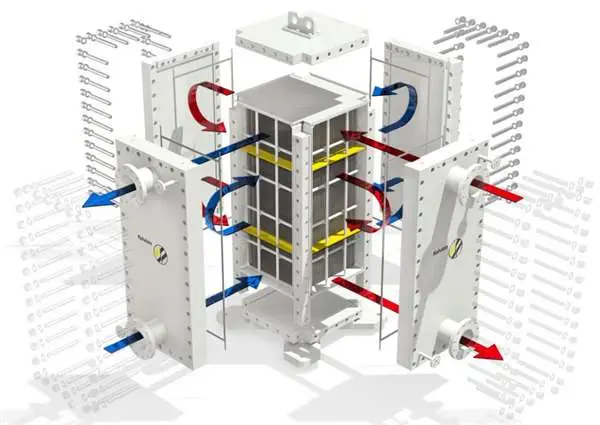
Fully Welded Construction: Provides exceptional mechanical strength and pressure resistance, ensuring reliability in the harshest operating environments.
Wide Application Range: Custom-made from a modular concept suitable for single-phase, condensation, vacuum condensation, and partial phase change duties for chemical processes and more.
A Welded Plate Heat Exchanger consists of a pack of thin, corrugated metal plates that are laser or plasma welded together at the edges to form a secure, gasket-free plate pack. Portholes allow the two process fluids to flow through alternate channels, creating a counter-current flow that drives highly efficient heat transfer between them. This robust, sealed design contains the fluids safely even under extreme pressure and temperature.
Our Welded Plate Heat Exchangers are available in a range of specifications to suit your needs. Contact our engineers for detailed datasheets.
Need a new welded plate heat exchanger, a like for like replacement, or expert advice on the best equipment for your application? Our team is ready to help you select the most reliable and efficient solution, engineered for Australia’s toughest conditions.
When you source your Welded PHE from us, you get more than just a product; you get a complete support partnership.
We provide expert advice to select and size the optimal welded plate heat exchanger for your application, ensuring you get the right technology for the job.
We supply new welded units to projects across Australia. Our team provides comprehensive support from initial specification through to delivery ensuring a seamless procurement process.
While these units are robust, they still require expert care. Our highly skilled technicians provide specialised on-site and workshop servicing, including advanced diagnostics and cleaning, to protect your investment and ensure long-term reliability.
Need a new unit, a like-for-like replacement, or expert advice on the best equipment for your application? Our team is ready to help you select the most reliable and efficient solution, engineered for Australia’s toughest conditions.
A welded PHE is used in applications with pressures, temperatures, or aggressive fluids that would cause a standard gasket to fail. It offers superior containment and strength but is less serviceable than a gasketed unit.
They are common in demanding industries like Oil & Gas, chemical processing, power generation, and specialised refrigeration, where operational conditions are extreme.
Yes they can be opened to and extent. While they cannot be opened like a gasketed unit, our specialists perform advanced on-site and workshop cleaning with a needle lancer and testing services to maintain their performance and integrity.
To provide an accurate proposal, we need to understand your process, including fluid types, temperatures, flow rates, and pressure requirements. Any available P&IDs or drawings are also helpful.